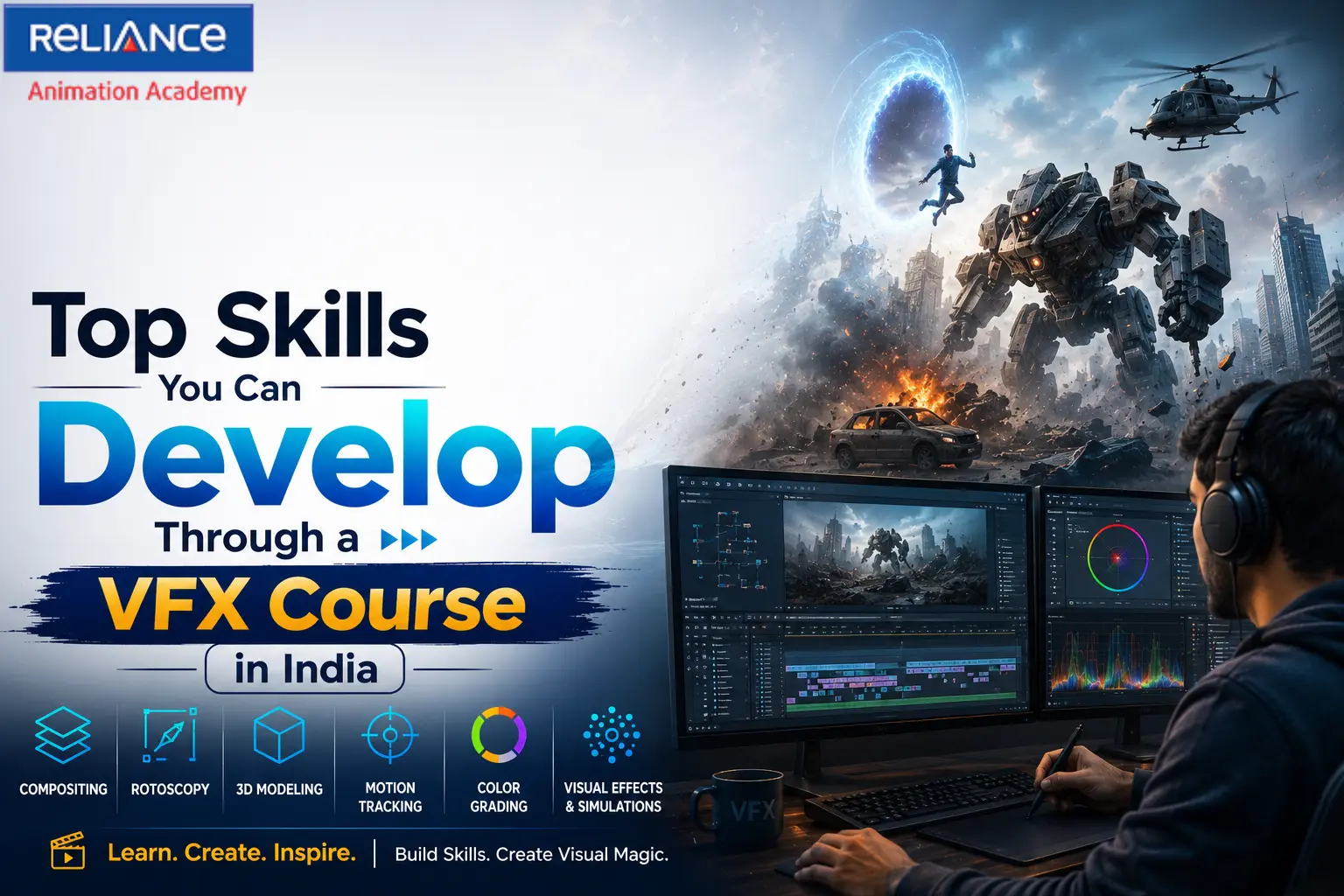
Top Skills You Can Develop Through a VFX Course in India
Every explosion in a Bollywood film, every dragon on an OTT series, every product that morphs mid-air in an ad, somebody built that on a computer, frame by frame. That somebody trained in VFX, and the skills they learned are more in demand in 2026 than they've ever been.
A VFX course in India isn't one skill; it's a stack of them. Compositing, 3D, rotoscoping, motion tracking, and now a fast-growing layer of AI tools that are rewriting how the whole pipeline works. OTT platforms, film, gaming, and advertising are all fighting over people who have them. This piece walks through the specific skills a good VFX course actually builds, where each one is used, and why the AI angle has become the thing that separates a future-proof artist from one about to be automated.
Key takeaways
- A VFX course builds a stack of skills, compositing, 3D modelling, rotoscopy, motion tracking, colour grading, not just one.
- Core tools taught include Nuke, After Effects, Maya and DaVinci Resolve, the software actual studios run on.
- AI is now part of VFX: tools like Runway ML and neural rendering are automating rotoscoping and compositing, so learning AI in VFX is a real edge.
- Demand spans OTT platforms, film, gaming studios and advertising, with salaries roughly ₹2.5-9 LPA and up with specialisation.
- A strong showreel of real shots matters more than any certificate; employers want to see what you can actually do.
What VFX actually is (and why the skills sell)
VFX, visual effects, is the craft of creating or altering footage that couldn't be filmed for real: the explosion nobody set off, the creature that doesn't exist, the city that was never built. It's how modern screen content gets made, and that's the short version of why the skills sell.
The demand isn't hype, it's structural:
- OTT platforms like Netflix, Prime and JioHotstar want high-production content, and every bit of it needs VFX artists.
- Film uses VFX on virtually every major release now, Bollywood, Tamil, Punjabi, all of it.
- Gaming studios need 3D modellers and environment artists, and gaming is one of the fastest-growing job markets going.
- Advertising and digital media run on CGI product videos, brand animation and social content.
A trained VFX artist isn't chasing one industry. They're holding skills four industries are bidding for.
The core technical skills a VFX course builds
This is the heart of it. A proper VFX course doesn't teach "VFX" as one blur; it builds distinct, named skills, each with its own job in the pipeline.
| Skill | What it is | Where it's used |
|---|
| Compositing | Layering multiple elements into one seamless shot | The backbone of almost every VFX shot |
| Rotoscopy | Cutting elements out of footage frame by frame | Green screen, object removal, isolation |
| 3D modelling | Building objects, characters and environments in 3D | Creatures, props, whole digital sets |
| Motion tracking | Matching CG elements to camera movement | Integrating 3D into live footage believably |
| Colour grading | Setting the mood and look through colour | Final polish on film, TV and ads |
| Particle & FX | Explosions, smoke, fire, destruction | Action sequences, disaster shots |
Compositing is usually where a career starts, it's the spine of the whole craft. The rest stack on top, and specialising deeply in one or two is often what lifts an artist's pay above the entry band.
The tools you'll actually learn
Skills need software, and studios run on specific packages. A course worth its fee trains you on the ones real productions use, not generic stand-ins:
- Nuke, the industry-standard compositing tool at serious studios.
- After Effects, for motion graphics and compositing, everywhere in the field.
- Maya, the workhorse for 3D modelling, rigging and animation.
- DaVinci Resolve, for colour grading and finishing.
- Fusion and Houdini at the higher end, for advanced compositing and effects.
Here's the thing to check before you enrol: are you learning the tools studios actually use? A course teaching only hobbyist software leaves you with a gap on day one of a real job.
Why AI has become a VFX skill of its own
This is the part that's changed fastest, and it's worth understanding because it cuts both ways.
AI is rewiring the VFX pipeline in real time. Tools like Runway ML and neural rendering are automating the slow, manual jobs, rotoscoping, parts of compositing, even 3D environment creation. That sounds like a threat, and for artists who ignore it, it is. For artists who learn it, it's the opposite: they do in an afternoon what used to take a week, and they become far more valuable for it.
Which is why "learn AI in VFX" has stopped being optional:
- AI handles the grunt work, freeing the artist for the creative calls.
- Studios increasingly expect familiarity with AI-assisted tools.
- The artists who pair traditional craft with AI fluency are the ones who stay ahead of automation instead of being replaced by it.
A modern VFX course that skips AI is teaching yesterday's pipeline. One that folds it in is teaching where the work is actually going.
The creative and career skills people forget
VFX gets talked about as pure tech, but the artists who rise have a second set of skills that matter just as much:
- An eye for detail and realism. The difference between a shot that convinces and one that doesn't is often invisible to everyone except a trained eye.
- Storytelling sense. VFX serves the story; an artist who gets that makes better creative decisions than one just executing tasks.
- Portfolio building. A showreel of 2-3 genuinely strong shots is the single most important career asset in this field, more than any certificate.
- Collaboration and deadlines. Studio work is team work under pressure; the ability to take direction and hit a deadline is what gets you rehired.
Employers, as one industry source puts it plainly, want to see how you think, not just the final render. The creative skills are what show them that.
VFX training at Reliance Academy, India
The skills only pay off if the course actually builds them on real tools with real project work, and that's where training programmes differ sharply. Reliance Academy runs VFX and animation training aimed at exactly this stack, the compositing, 3D, rotoscopy and motion-tracking skills studios hire for, with the industry tools and AI-assisted workflows the field is moving toward, and a focus on building a portfolio you can actually show.
If you're comparing a VFX course, weigh each option on what matters:
- Does it train you on studio tools like Nuke, After Effects and Maya, not just hobbyist software?
- Does it cover AI-assisted VFX, or is it teaching the old pipeline?
- Do you leave with a real showreel, or just a certificate?
The team can walk you through the curriculum and what students actually produce.
The bottom line
A VFX course in India builds a genuine stack of in-demand skills, compositing, 3D, rotoscopy, motion tracking, colour grading, on the tools studios actually run, and increasingly the AI workflows reshaping the whole craft. Four industries are hiring for those skills, and the artists who pair solid technical craft with AI fluency and a strong showreel are the ones who thrive. Learn the real tools, embrace the AI shift, build the portfolio, and VFX is one of the more future-proof creative careers going.
Thinking about a VFX course in India? Explore the programmes at Reliance Academy to see the skills, tools and AI workflows the course covers, and what past students have built.
.webp)